How to build a company brain without burning trust
Contents10
Seven steps that decide whether a company brain survives its first year, what goes wrong in real companies and how to expand without losing trust.
A 4-part series on building a company brain.
Part 1: What a company brain is and what it isn’t
Part 2: The architecture (forthcoming)
Part 3: How to build a company brain without burning trust (you are reading this)
Part 4: A product team worked example (forthcoming)
Part 1 covered what a company brain is. This part is about what happens when you try to actually build it inside a real company with budgets, politics, regulators, legacy systems and overloaded teams.
Most company-brain programs don’t fail at the model. They fail at organizational readiness.
1: Assess whether your company is ready
Every demo you’ve seen starts the same way: connect to the tools, show a pretty answer, demonstrate a citation, end with an agent doing something useful. The successful programs start the opposite way: spend the first month answering uncomfortable questions about whether the organization is ready to be remembered.
Start with a 90-minute executive diagnostic. Five dimensions, scored 1 to 5, by each leader independently:
Documentation culture. When someone solves a hard problem, do they write it down or does it stay in their head? When a decision gets made in a meeting, is there a record a stranger could find? 1 = it’s all tribal. 5 = writing things down is part of how work gets done.
Content hygiene. Of the documentation you do have, what percentage is current, owned by a named person and findable? 1 = Confluence is a graveyard. 5 = every important page has an owner and a review date.
Access governance. Could you reliably tell what a frontline support agent can and can’t see across your tools? 1 = ad hoc per tool. 5 = unified IdP, formal RBAC enforced.
Leadership alignment. Is there a named exec sponsor with authority and time? Have HOD and function leads committed in writing? 1 = people nod and move on. 5 = it’s in their OKRs.
Operational capacity. Can you actually staff this without it being a side-of-desk effort? 1 = everyone’s drowning. 5 = dedicated team, ring-fenced budget.
Add the scores. The numbers are a rough guide, not a calibrated scale.
- Low totals across the board are a signal to invest in foundations first (documentation discipline, content hygiene basics, sponsor identification) and revisit the program in a quarter or two.
- Mid-range scores mean you can start, in parallel with finishing the foundations; pilot in a few months, not month 1.
- Consistently high scores across all five dimensions mean you have enough organizational maturity to start now.
Treat high self-scores with skepticism. The useful signal is where leaders disagree.
2: Don’t confuse extraction with trust
The knowledge people rely on most is often not in the docs. It lives in Slack threads, escalation habits, old incidents and the judgment of a few experienced people. Every company brain demo you’ve seen ingests existing documentation and makes it searchable. That’s the easy part. The hard part is that the documentation you most need doesn’t exist yet.
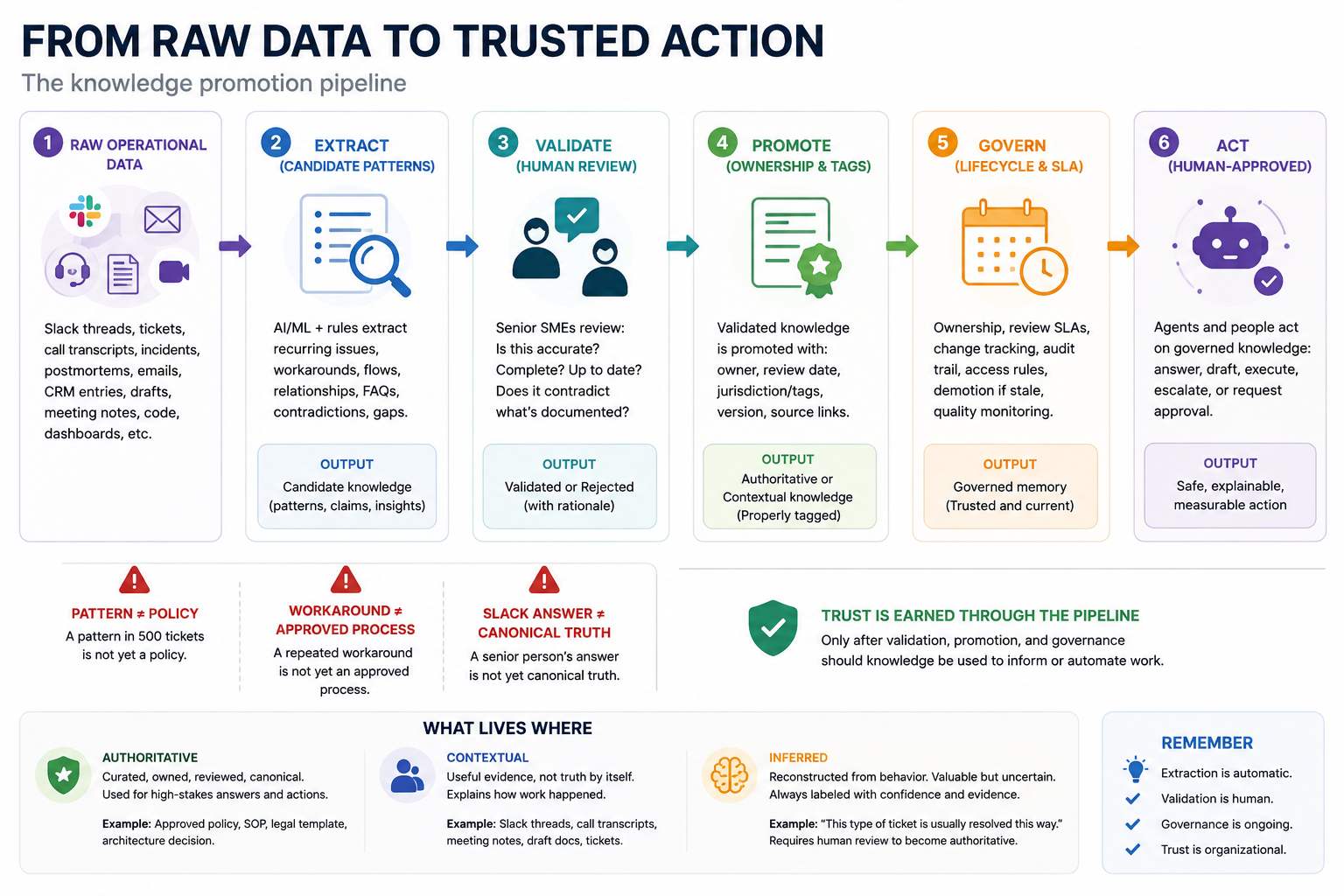
Some vendors can help here. Modern extraction systems run over raw tickets, Slack threads, escalations and postmortems and surface candidate knowledge: recurring issues, undocumented workflows, common resolutions, contradictions, draft FAQs.
Candidate knowledge does emerge automatically from raw operational data, but extracted structure is not the same as trusted memory.
- A pattern in 500 support tickets is not yet a policy.
- A repeated workaround is not yet an approved process.
- A senior person’s Slack answer is not yet canonical truth.
Avoid the trap of thinking extraction alone creates the context layer.
- Extract. Auto-extraction over a bounded data cut. Vendor or in-house.
- Validate. Senior employees review the extracted patterns: is this actually the procedure, does this contradict what’s documented, would the regulator accept this answer?
- Promote. Validated patterns get named owners, review dates and tags. Unvalidated patterns stay contextual and are never served as authoritative.
- Govern. Ownership and review SLAs apply from the moment of promotion.
- Act. Only after the memory is governed do agents get to act on it.
Most plans treat validation, promotion and governance as automatic. That’s the trap. Only the extraction step is automatic. The rest is organizational work. That’s where most programs stall.
3: Focus on content ownership
The single biggest reason these systems rot 6 months after launch: nobody owns the content.
At launch, content is fresh, accuracy is high, leadership is excited. A few months later products, policies and processes have changed, but the content has not. Stale content erodes people’s trust and adoption stops. Eventually the company starts looking for a new vendor, even though the real problem was ownership.
Three structural changes prevent this. None of them are technical:
- Every authoritative page has a named owner. The owner is identified in the metadata, visible in citations and accountable in their OKRs.
- Every authoritative page has a review date. When the date passes, the page auto-demotes to “Under Review” status and is excluded from authoritative retrieval until the owner re-certifies or retires it.
- Content owner SLA compliance is reported up. If leads or function owners are missing review dates, their managers see it in a monthly report.
The cultural piece is harder than the structural one: content ownership is a real job, not “and also.” Make it part of the relevant person’s OKRs and reserve explicit time for review and maintenance.
An unowned company brain doesn’t just go stale. It becomes a rumor engine with citations.
4: Put a senior operator in charge
The strongest predictor of program success isn’t budget. It isn’t the vendor. It isn’t even executive sponsorship, though that matters. It’s the program lead.
The program lead needs unusual range. Senior enough to push back on HODs and function heads who have other priorities. Technical enough to make architecture calls without deferring to engineering on everything. Organized enough to drive content discipline across a federated org. Culturally credible enough that people actually do what they ask.
A program lead who is technically right but politically tone-deaf will produce a great architecture and zero adoption. A program lead who is politically savvy but technically weak will produce great adoption of the wrong system.
If you can’t find the right senior owner, run it through the CEO office until you can.
5: Right-size the MVP
Don’t start with: “Let’s connect everything.” Pick the right use case for a defensible MVP.
A defensible MVP might look like this:
- One unit, country or business unit (whichever is the smallest defensible operating boundary; pick the one with the cleanest content and the strongest governance bar)
- One function (Customer Support is a common starting point: clear ROI signal, high volume of repeated questions and manageable risk if the first pilot is internal or human-reviewed)
- One or two high-value workflows
- A small set of source systems (typically the wiki, the support tool and the CRM)
- A bounded slice of curated authoritative content with named owners (a few hundred pages, not a few thousand)
- Full compliance overlays from day one (audit logging, PII redaction, refusal logic; these don’t get deferred, even in MVP)
- A small cohort-one user group, expanding modestly by pilot end
- A frozen evaluation set with SME-verified answers, mixing routine questions, edge cases, synthesis questions and a handful where the correct answer is “I don’t know, escalate to X”
The pilot succeeds when it clears pre-agreed quality and trust thresholds: high accuracy on the frozen evaluation set, strong user trust scores and correct refusals on questions the system shouldn’t answer. Don’t expand until those thresholds are met.
The temptation will be enormous. You’ll have an architecture review where someone says “what about sales?” or “what about engineering?” or “what about the next region?” Don’t say yes. The cost of saying no is short-term irritation. The cost of saying yes is a half-baked system that does five things badly instead of one thing well.
6: Don’t treat the eval harness as optional
A company brain without a serious eval harness is a liability, especially in regulated environments.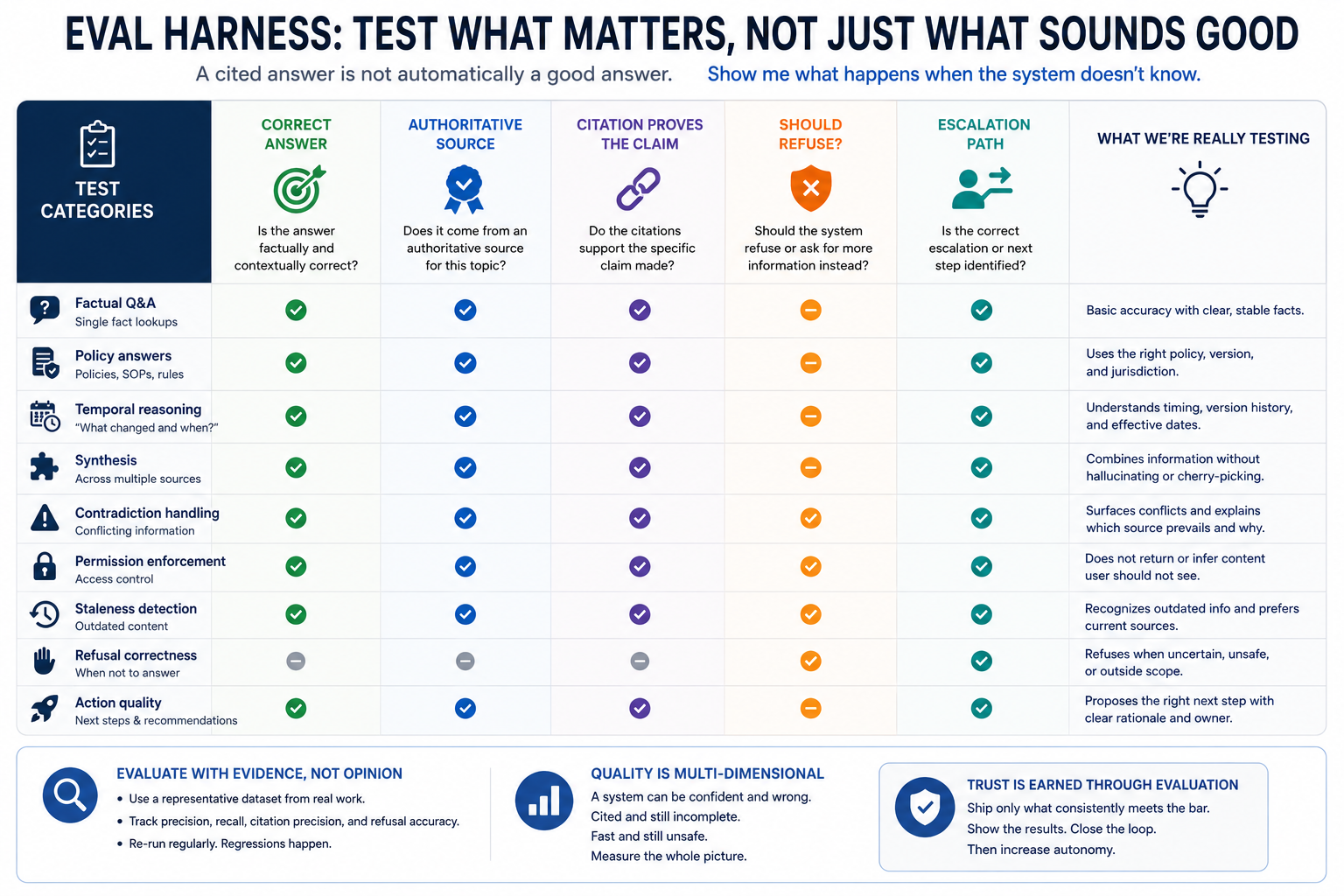
The frozen reference set should be built before launch, not after users complain. It should test the core capabilities (factual Q&A, policy answers, temporal reasoning, synthesis, contradiction handling, permission enforcement, staleness detection, refusal correctness, action quality), not just answer accuracy.
Cited answers are not automatically good answers. Many enterprise RAG systems produce citations that are adjacent to but don’t actually support the claim. The model retrieves a relevant document and asserts a fact the document doesn’t quite say. This is worse than no citation, because it creates false confidence. For regulated work, every high-risk answer should be evaluated on three questions: is the answer correct, is the cited source authoritative and does the citation actually prove the answer?
Refusal rate is a positive metric. A confident wrong answer about KYC procedure isn’t a productivity issue; it’s a license risk. A 0% refusal rate on a realistic regulated eval set is suspicious. The eval harness should measure refusal correctness, refusing when authoritative source is missing and not refusing when it isn’t. Both kinds of error matter.
A company brain that cannot refuse is not a company brain. It’s a liability with a friendly interface.
The vendor question I’d ask in every demo: “Show me what happens when the system doesn’t know.” The ones who can’t show it haven’t built a system; they’ve built a demo.
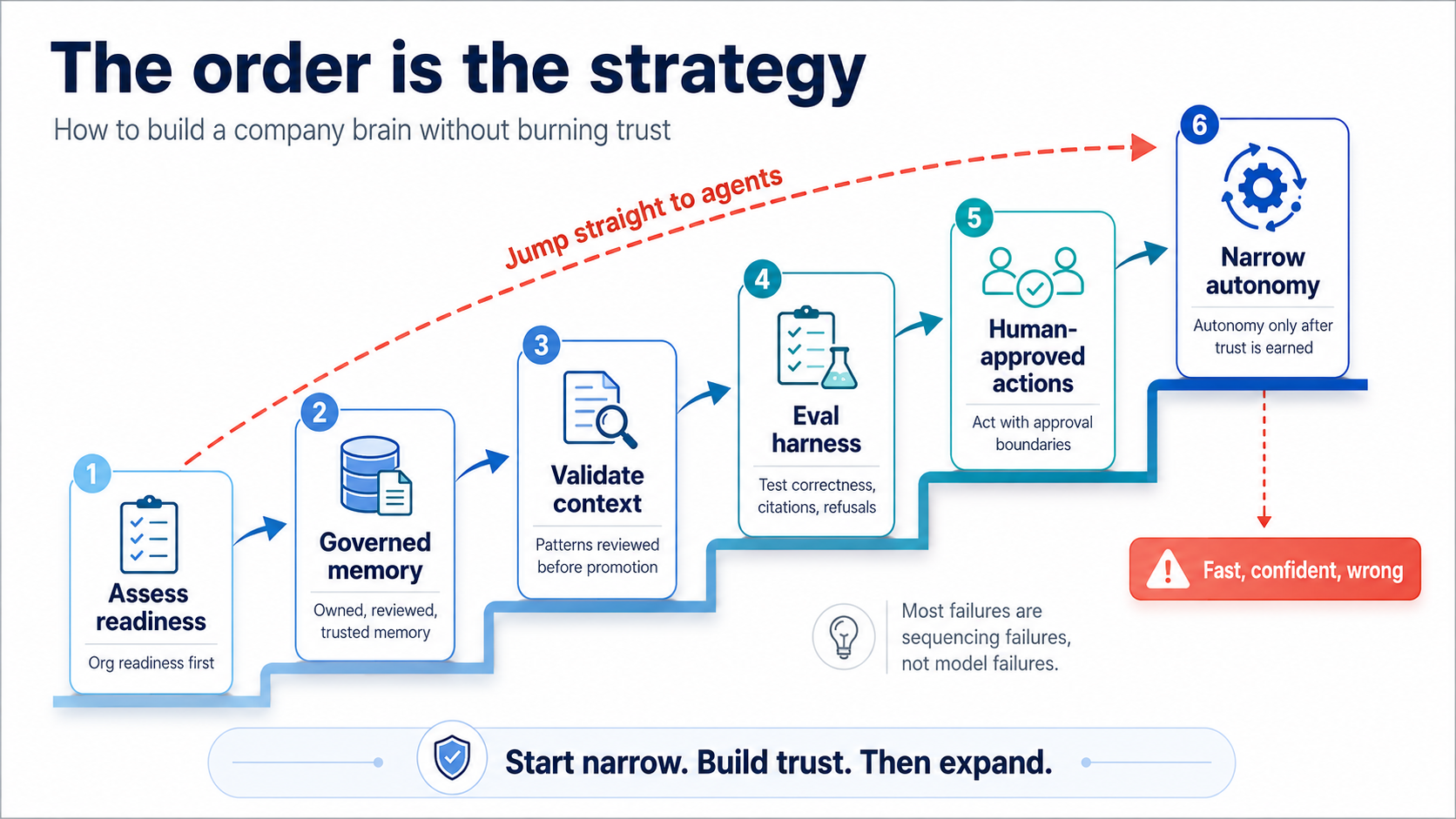
7: Don’t jump from Layer 1 to agents
Skipping ahead is the most tempting mistake and the one executives will push hardest for.
The demo cycle is always about agents. The reality cycle has to be about memory. If you don’t have source hierarchy, versioning, permissions, ownership, evals and refusal behavior, an agent only gives you a faster way to make mistakes.
The maturity curve:
Cited Q&A
  ↓
Version-aware synthesis
  ↓
Decision reconstruction
  ↓
Drafting and recommendations
  ↓
Human-approved workflow actions
  ↓
Narrow autonomous execution
Skipping steps feels faster, but you’ll end up with agents that are confident, fast and wrong.
Adjacent first, ambitious later
Once the first use case works, the pressure will be to roll it out everywhere.
The next expansion shouldn’t go to the loudest voice in the room or the team with the prettiest demo request. It should go where the system has the best chance of creating value without breaking trust.
A good next use case usually has five traits:
- Reuse. It reuses what you already built: sources, permissions, content owners and evaluation patterns. Moving from support FAQs to support escalations is a natural step. Jumping from support FAQs to finance approvals is not.
- Pain. People are already wasting time looking for answers, asking senior people, recreating context or explaining the same thing again and again. If the pain is vague, adoption will be vague.
- Manageable downside. A wrong internal answer that gets corrected by a human is very different from a wrong answer sent to a customer or used in a regulated decision.
- Ownership. Someone is willing to maintain the knowledge. The system rots fastest where ownership is weakest.
- Evaluability. SMEs can write down what a good answer looks like. If they can’t, the system isn’t ready to scale into that workflow.
The natural expansion path is usually adjacent, not ambitious:
Support FAQs → support escalations → customer-success handoffs → product feedback synthesis → sales enablement → compliance evidence retrieval → human-approved workflow actions
The exact order will vary by company. The principle does not.
Expand where the memory can be reused, the pain is real, the risk is manageable, the owner exists and the output can be evaluated. In regulated or licensed environments, add one more rule: don’t cross a new regulatory boundary and increase autonomy at the same time. For less-regulated environments you can move faster, but the same principles apply; the action boundary just expands sooner.
Build versus buy: a more honest split
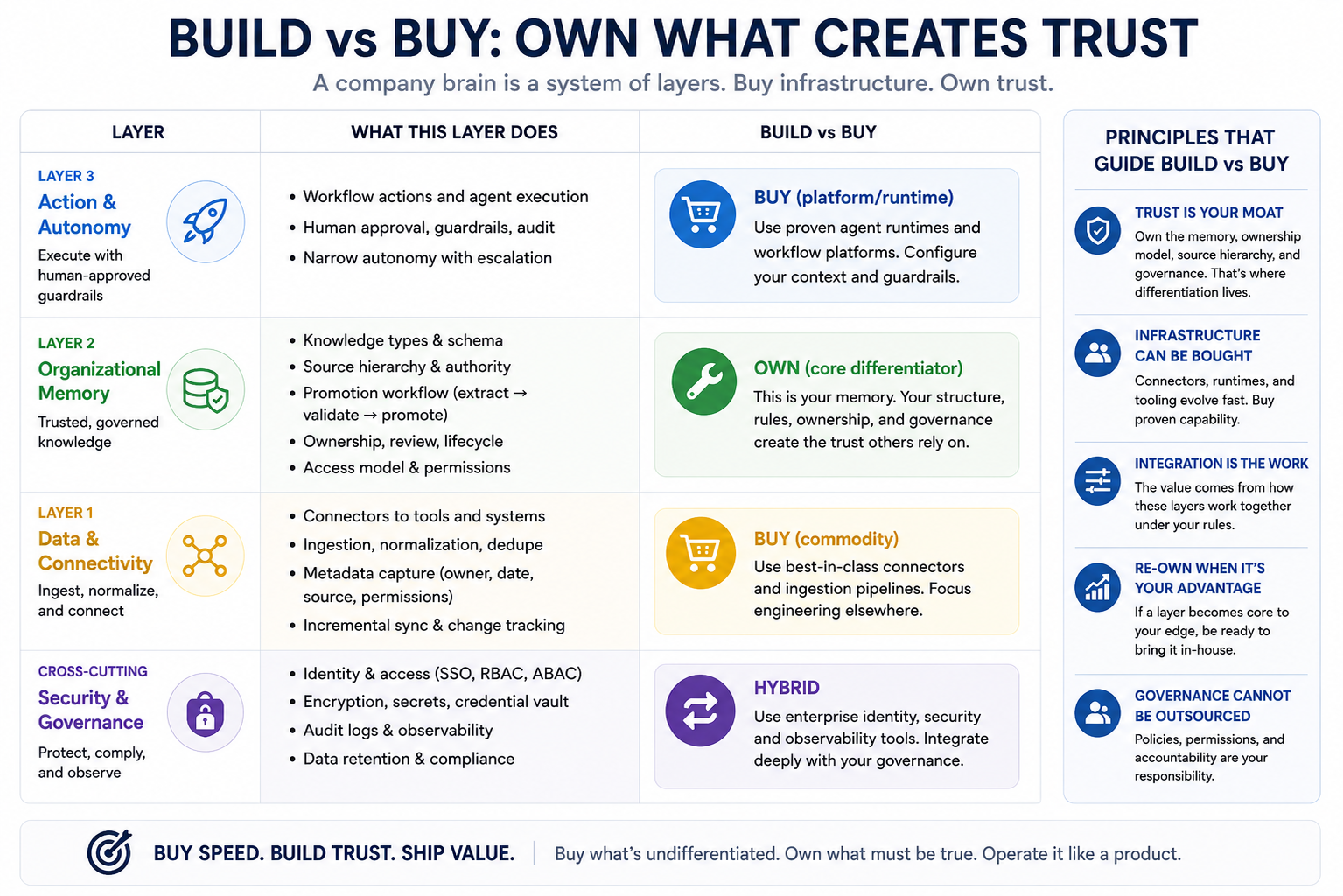
Most companies should not build everything from scratch. They should also not buy a single vendor as the whole answer. The honest split is layer-by-layer:
| Layer | Recommendation | Why |
|---|---|---|
| Connectors | Buy | Mature, well-tested, MCP standardizing them |
| Raw-data extraction | Buy or partner | Vendors can surface candidate knowledge from messy operational data |
| Basic retrieval | Buy or use platform | Largely commoditized; rarely the source of differentiation |
| Memory schema | Often own | Reflects your specific entities and edges |
| Access model | Must own | Your identity provider, your roles, your jurisdictional rules |
| Source hierarchy | Must own | Only you know what’s authoritative in your company |
| Promotion workflow | Must own | Extracted knowledge needs review before becoming trusted memory |
| Eval harness | Must own | The questions and verified answers are yours |
| Content lifecycle | Must own | Ownership and review processes are organizational |
| Agent runtime | Buy or platform | Cowork, Managed Agents or equivalent |
| Workflow integration | Hybrid | Existing platforms (Zapier, ServiceNow) plus custom |
| Governance model | Must own | Compliance and audit are yours alone |
The dangerous mistake is outsourcing the thinking. A vendor can provide infrastructure. They cannot decide what your company considers authoritative. They cannot define your regulatory risk appetite. They cannot know which jurisdictional boundaries matter. They cannot force your leaders to maintain content. They cannot create organizational trust on your behalf.
Summary
The technology matters. But it isn’t the hard part. The hard part is helping the company remember itself accurately enough that humans and agents can act on that memory safely.
Don’t organize the whole company upfront. Don’t trust extracted context blindly. Start narrow. Extract from raw data. Validate with humans. Promote into governed memory. Keep it fresh. Expand only when trust holds.
You can buy a better LLM. You cannot buy organizational discipline.
Part 4 takes one product-team workflow from feature request to PRD and shows how the substrate, context graph, permissions, evaluations and action boundaries work together in practice.