Taking Inkling 2 Mini for a spin on NVIDIA GB10
Contents8
Inkling 2 Mini launched on 20 November and quickly caught my attention. It has 26.4B parameters with just 3.4B active, a million-token context window and benchmark results close to a dense 27B model.
I had a GB10 home lab running a couple of local models, so this seemed like a good opportunity to see what Inkling could do on a single machine. I tested generation speed, speculative decoding, memory consumption, long-context handling and a small suite of coding and agent tasks.
The interesting part was how the measurements pulled apart. Inkling generated tokens more slowly than my existing Qwen3.6 model, but at medium reasoning effort it completed at least as many tasks in less time. Its architecture also revealed some useful details about memory bandwidth and KV-cache requirements on GB10.
1. Getting Inkling running
My lab uses an MSI EdgeXpert, built around NVIDIA’s GB10 platform (the chip in the DGX Spark) with 128 GB of unified CPU/GPU memory. I’ve covered the hardware, software and safeguards in Building a home AI lab on NVIDIA GB10.
I normally keep two models running through vLLM. Each gets a share of memory through vLLM’s --gpu-memory-utilization setting:
| Model | Role | Memory allocation |
|---|---|---|
| Qwen3.8-27B | Main model for Hermes Agent | 34% |
| Qwen3.6-35B-A3B | Secondary model | 31% |
Inkling looked like a good candidate for the second slot. A few details from its release:
| Property | Inkling 2 Mini |
|---|---|
| Release | 20 November 2026, Apache-2.0 |
| Architecture | 26.4B parameters, 3.4B active |
| Model type | Mixture of experts |
| Inputs | Text and images |
| Context | Up to 1M tokens |
| Layer looping | Layers 6 to 17 execute three times |
| Draft model | DSpark, 7 speculative tokens |
In a mixture-of-experts model each token passes through only a few expert blocks, so 3.4B of Inkling’s 26.4B parameters do work for each token. Qwen3.6-35B-A3B is built the same way with 3B active.
The published benchmarks were encouraging. Thinking Machines Lab reported competitive coding results, while independent Artificial Analysis measurements placed Inkling close to Qwen3.8-27B on its Intelligence Index.
I stopped Qwen3.6, loaded Inkling on port 8001 and kept the 27B running on port 8000. The standard NVIDIA vLLM container didn’t yet support Inkling, so I used the model-specific vLLM image with pinned weights, FP8 KV caching and a 131,072-token context window. Cold start took 266 seconds.
Results at a glance
Speed for one request of 1,024 output tokens at temperature 0.6 and the total with four requests at once:
| Measurement | Inkling | Qwen3.6 | Qwen3.8-27B |
|---|---|---|---|
| Code prompt, tok/s | 50 | 108 | 56 |
| Essay prompt, tok/s | 33 | 90 | 27 |
| Four requests at once, total tok/s | 70 | 198 | 91 |
All three models used their own draft models. A draft model is a small model that guesses several tokens ahead for the main model to check in one step. The Qwen models ran with thinking off and Inkling at reasoning effort none, which still reasons. On the code prompt all 1,024 of its tokens were reasoning about the code. The Qwen speeds come from my earlier benchmarks on the same box.
On a suite of 26 coding, maths, tool and agent tasks, with Inkling and the 27B at medium effort and Qwen3.6 with thinking on:
| Measurement | Inkling | Qwen3.6 | Qwen3.8-27B |
|---|---|---|---|
| Tasks passed, of 26 | 22.7 (21 to 24) | 21 | 25.3 (25 to 26) |
| Time for the suite | 18.1 min | 22.0 min | 16.5 min |
| Output tokens | 61k | 134k | 49k |
Inkling and the 27B figures are averages of three runs; Qwen3.6 ran once.
2. Understanding Inkling’s generation speed
With its draft, Inkling generated 50 tokens per second on the code prompt and 33 on the essay. Without the draft it settled at 38.4 on both.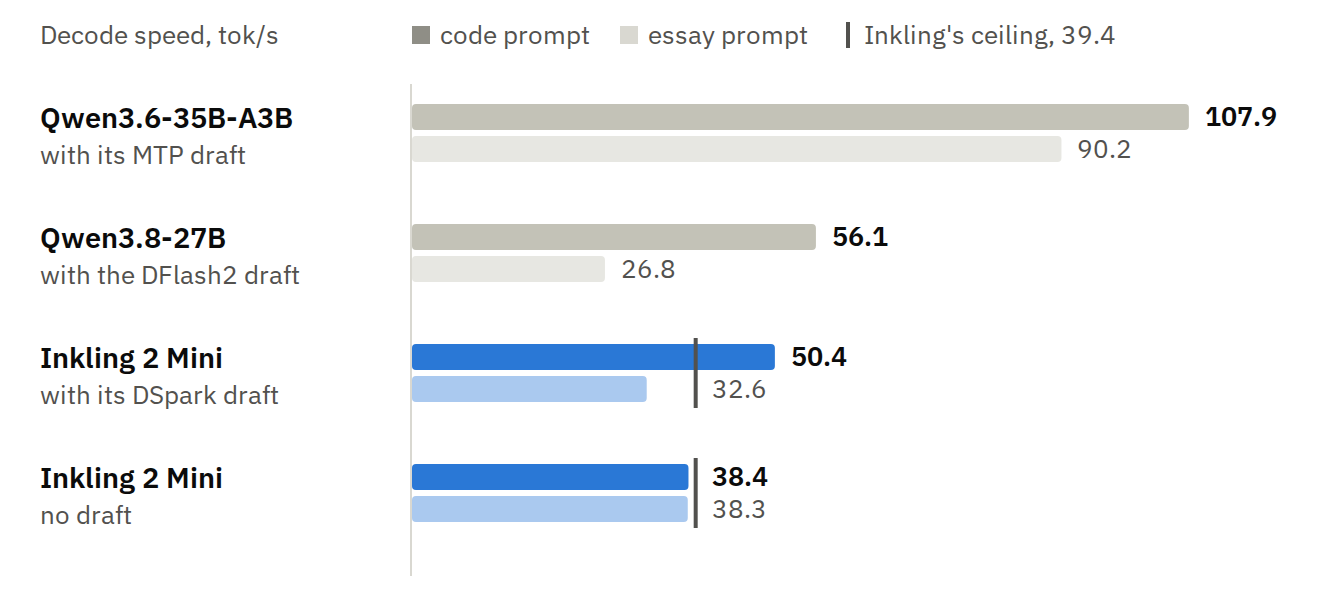
Given the 3.4B active-parameter figure, I was curious why Qwen3.6, with 3B active, reached 108 tokens per second on the same prompt.
On GB10, single-user decoding is often constrained by memory bandwidth, because the GPU needs to read the relevant model weights for each generated token. Inkling uses layer looping: layers 6 to 17 execute three times, sharing the same stored weights. This reduces the number of unique parameters stored in memory, but those weights are still read and processed on every pass.
I inspected the safetensors metadata to estimate the weight data read per generated token.
| Component | Data read per token |
|---|---|
| Selected experts | 1.84 GB |
| Attention and other weights | 2.79 GB |
| Output layer | 0.93 GB |
| Total | 5.55 GB |
The looped layers account for 3.42 GB of that, 62% of the total.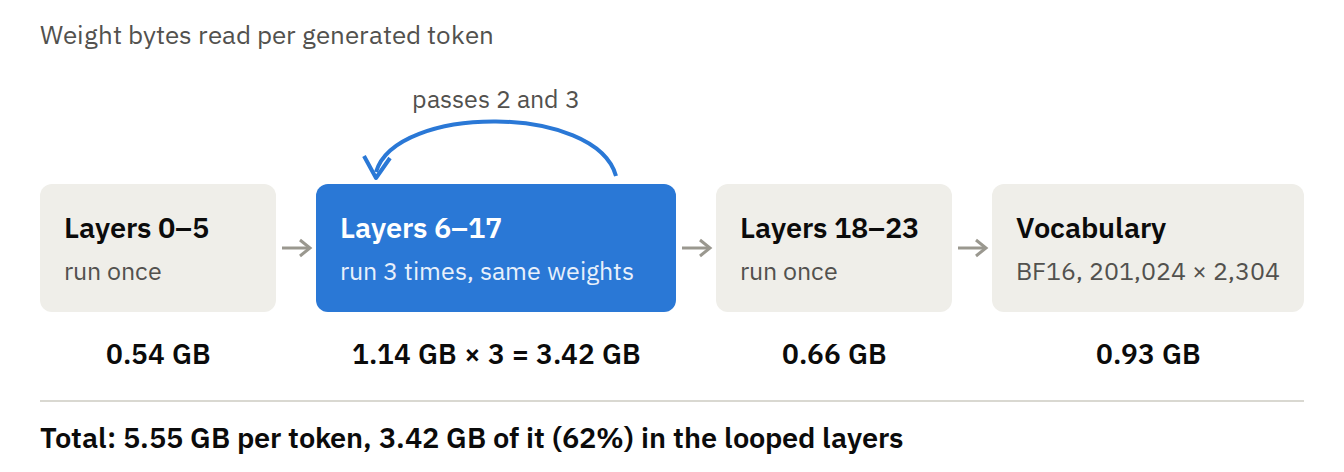
A GB10 memory-copy benchmark by outsmartchad measured 219 GB/s, against NVIDIA’s specified 273 GB/s. Dividing that bandwidth by the bytes per token gives a decoding limit:
219 GB/s ÷ 5.553 GB per token = 39.4 tokens per second
My measured speed without speculative decoding was 38.4 tokens per second, a close match. The same count gives Qwen3.6 2.58 GB per token and a limit of 84.9 tokens per second, while the 27B reads every weight for every token: 17.61 GB and 12.4. Qwen3.6’s 108 came with its own draft, above that limit.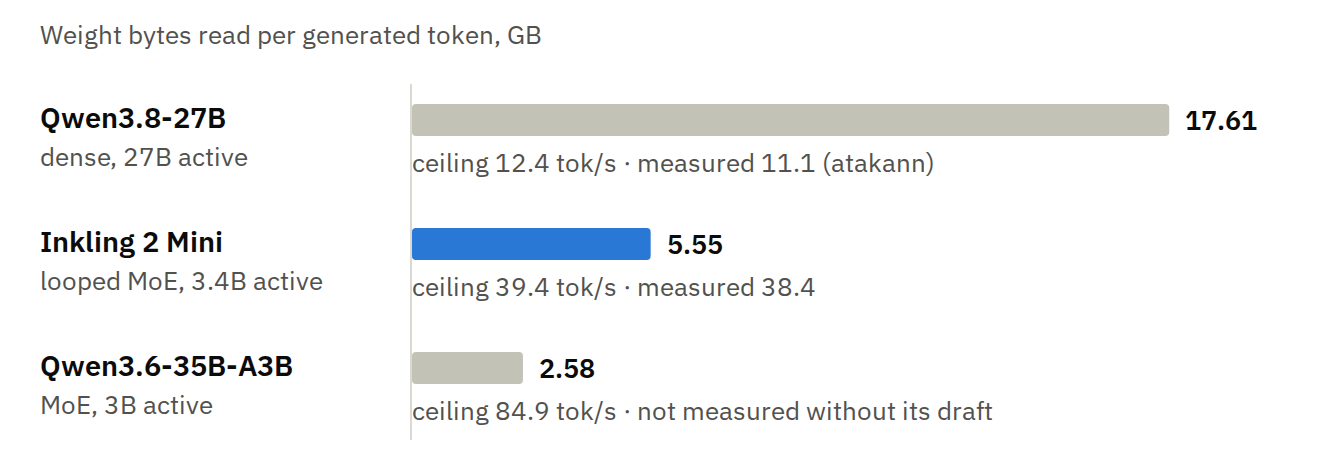
Inkling is already operating near the memory-bandwidth limit for this workload. The 3.4B active-parameter figure describes the architecture, but the amount of weight data read per token is a better predictor of decoding speed on this hardware.
What difference does DSpark make?
DSpark proposes seven tokens at a time and the main model checks them together, so one decoding step can produce several tokens. The gain depends on the workload:
| Test | Without draft | With DSpark | Change |
|---|---|---|---|
| Code prompt | 38.4 tok/s | 50.4 tok/s | +31% |
| Essay prompt | 38.3 tok/s | 32.6 tok/s | −15% |
| Four requests at once | 78.6 tok/s | 70.2 tok/s | −11% |
The code prompt gained and the other two lost. Measured one prompt at a time, the code prompt, whose output was all reasoning, averaged 3.0 tokens per decoding step out of a possible eight, against 1.9 for the essay. The whole short benchmark averaged 2.35. On the reasoning-heavy task suite the average rose to 3.48, with vLLM reporting about 55 tokens per second for a single request.
I’ve kept it enabled for now, given the reasoning-heavy tasks I’m testing.
3. Memory behaviour at 131k context
Besides the weights, vLLM reserves memory for the KV cache, which holds the attention state for every token of context.
Inkling wouldn’t start at the 31% memory allocation I had been using for Qwen3.6 with a 131,072-token context window. After increasing the allocation to 36% and enabling FP8 KV caching, it loaded successfully alongside the 27B. vLLM reported the following at startup:
| Measurement | Qwen3.6 | Inkling |
|---|---|---|
| Memory allocation | 31% | 36% |
| Available KV cache | 3.5 GiB | 19.48 GiB |
| Cache size | 276,313 tokens | 144,147 tokens |
| Full 131k requests it holds | 2.11 | 1.10 |
| Idle process memory | 39.8 GiB | 40.0 GiB |
Both processes occupied about 40 GiB when idle. With under a fifth of the cache memory, Qwen3.6 holds almost twice as many tokens: two full-length requests against Inkling’s one. Shorter requests allow more at once.
Why FP8 helps less than expected
FP8 stores each cached attention value in eight bits instead of 16. Inkling also keeps sliding-window caches and a convolution state for each layer, some of which remains at higher precision. At the original 31% allocation, vLLM estimated:
| Cache format | Required for 131k | Available |
|---|---|---|
| BF16 | 21.14 GiB | 15.4 GiB |
| FP8 | 15.89 GiB | 14.63 GiB |
FP8 reduced the requirement by 25%. Comparing vLLM’s estimates at different context lengths suggests about 13.4 GiB of the FP8 requirement is fixed, while the rest grows by 18 to 20 KiB per token. Qwen3.6’s cache grows by about 10 KiB per token, plus its draft.
I haven’t isolated the fixed part; a smaller --max-num-batched-tokens is the first setting I’ll try. At the current 36% allocation, Inkling runs alongside Qwen3.8-27B while leaving about 30 GiB available for the host.
4. Long context
Inkling advertises support for up to one million tokens. I configured 131,072 tokens and sent prompts of up to 104,082.
That prompt, the suite’s passphrase test, shows a tokenizer cost. Inkling turned it into 104,082 tokens where Qwen’s tokenizer made 85,922, 21% more for the same text. So a 131k-token window holds less material on Inkling than on the Qwen models.
I also measured time to first token with a separate prompt of about 110,000 characters, which Inkling counts as 34,800 tokens and Qwen as 28,400.
| Model | First run | Second run |
|---|---|---|
| Qwen3.6 | 5.7 s | 4.8 s |
| Qwen3.8-27B | 12.5 s | 12.3 s |
| Inkling | 21.5 s | 11.8 s |
Inkling’s first run included one-time kernel compilation, so the second run is the one to plan with.
Tech2Wild also demonstrated retrieval at nearly one million tokens, although processing a 950k-token prompt took 26.5 minutes before the first output token. I haven’t tried that length yet; 131k is my starting point while I look at latency and concurrency under sustained work.
5. Putting Inkling through 26 tasks
Generation speed is useful to measure, but I was more interested in how the model would handle actual work. I ran a suite of 26 tasks:
| Category | Tasks |
|---|---|
| Code | 5 programming problems |
| Bug fixes | 2 |
| Maths and logic | 4 |
| Instruction following | 2 |
| Tool selection | 8 |
| Repository-based agent work | 2 |
| Long-context retrieval | 1 |
| Image understanding | 2 |
Unit tests checked the code and bug fixes, while maths answers had known reference solutions. Tool-selection tests checked the first tool call and its arguments. Repository tasks used file and test-running tools. All model-generated code ran in an isolated container without network access or privileges.
Each configuration ran at the publisher’s sampling defaults, with an output limit of 16,384 tokens per task. Inkling at medium and the 27B ran three times; the rest ran once.
Results
| Model and effort | Score | Output tokens | Time |
|---|---|---|---|
| Qwen3.8-27B, medium, average of 3 | 25.3/26 | 49k | 16.5 min |
| Qwen3.6, thinking on | 21/26 | 134k | 22.0 min |
| Inkling, high | 21/26 | 92k | 27.3 min |
| Inkling, medium, average of 3 | 22.7/26 | 61k | 18.1 min |
| Inkling, low | 21/26 | 40k | 12.7 min |
Qwen3.8-27B completed 25 or 26 of the 26 tasks in each run, consistent with its role as my main model. Inkling completed 21 tasks at every reasoning effort on the first run, matching Qwen3.6’s total. At medium it averaged 22.7 over three runs.
The bigger differences were in output length and completion time. At medium effort, Inkling generated 55% fewer tokens than Qwen3.6 and finished the suite 18% sooner on average. At low effort, it took just 12.7 minutes.
On the first run the three efforts scored the same, although the tasks passed varied between them. Medium solved four of five coding problems while low solved three, though low performed better in tool selection. Low and high ran once, so those differences are first observations.
The repeats at medium reversed one first-run result. Inkling had finished in 16.9 minutes against the 27B’s 18.4, but over three runs the 27B averaged 16.5 minutes against Inkling’s 18.1 while scoring higher in every run. Against Qwen3.6’s single run, Inkling’s averages still came out ahead on score, time and tokens.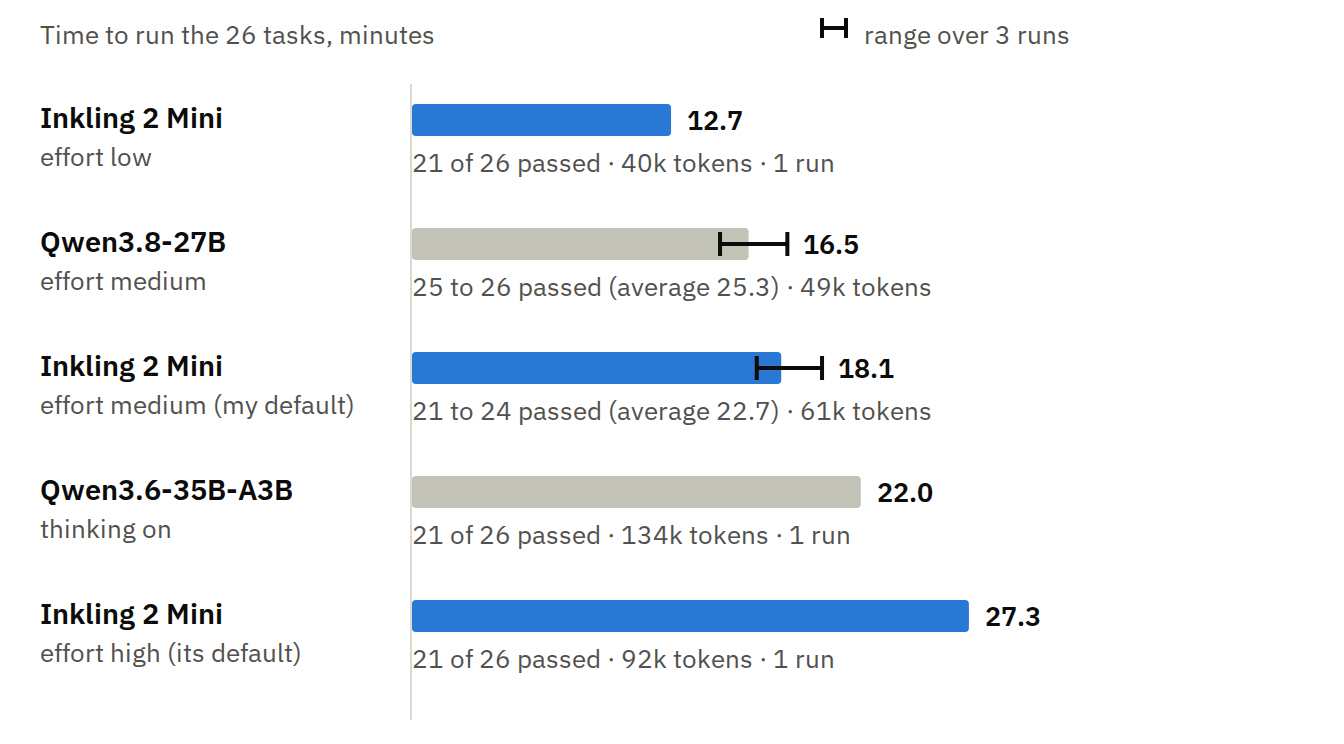
Tool use: some unexpected choices
Both Qwen models selected the expected tools in all eight tests. Inkling’s results varied by effort:
| Effort | Correct tool choices |
|---|---|
| High | 5/8 |
| Medium | 6/8, then 6/8 and 7/8 in the repeats |
| Low | 7/8 |
Every miss came from one of three requests. I also ran the tool tests twice more at medium with temperature 0.2, so each case below counts seven Inkling runs.
Asked to send an email about a meeting moving to 3pm tomorrow, Inkling checked the date through a shell command first, in all seven runs. Given a second turn, it sent the right email in each of three tries, with “tomorrow” turned into the actual date.
Asked to list /var/log, it used ls -la once instead of the dedicated directory-listing tool. Asked to translate “good morning” into Japanese, it gave the correct translation directly instead of using the translation tool, in four of seven runs.
In each case Inkling still served the request by its own route. For an agent system that’s a problem when the skipped tool exists for authorization or an audit trail. Two of the three cases also went to the shell when a dedicated tool was available.
Tech2Wild saw the translation answered without the tool only with an FP8 cache, which all my runs used, so BF16 is a useful follow-up experiment.
The two repository tasks passed in all 18 runs across every configuration and repeat. Inkling finished each of its runs in five or six turns without modifying the tests, so the repository results look promising while tool routing deserves a closer look.
What happens when reasoning runs long?
One coding task involved implementing RFC 6902 JSON Patch. Inkling worked through the problem but reached the 16,384-token output limit without a working solution in all five of its runs, at every effort. Each attempt took about five minutes. Qwen3.8-27B completed the task in all three of its runs.
Thinking Machines Lab’s model card mentions occasional extended reasoning loops, particularly during debugging. It happened every time on this task.
The long-context retrieval task produced an unusual result. I planted a passphrase inside a large source-code input. At medium effort, Inkling located it but declined to return it in three of six runs (the suite’s three and three separate checks), interpreting the request as exposing a secret. At low and high effort, in one run each, it returned the passphrase.
One run each is too few for a conclusion, but it suggests reasoning effort changes more than the number of generated tokens.
6. Comparing notes with other GB10 experiments
Other single-Spark owners published the same measurements:
| Measurement | Mine | Other reports |
|---|---|---|
| Decode without draft | 38.4 tok/s | 37.8 (outsmartchad), 39.4 (Classmethod) |
| Weight traffic | 5.55 GB/token | 5.50 (outsmartchad) |
| Draft acceptance, short benchmark | 2.35 tokens/step | 2.35 (outsmartchad) |
| Four requests at once, total | 70 tok/s | 87 (Classmethod, no draft), 91 (thefullctx), 94 (outsmartchad) |
| Cold start at 131k | 266 s | 265 s (Classmethod, no draft) |
Raw decoding speed and weight traffic agree closely, which supports the bandwidth calculation. With the draft, my numbers ran lower.
Rerun under the conditions thefullctx used, high effort and 512-token answers, my code prompt reached a median of 48 tokens per second against their 54 to 63. With 512-token answers my four-request total rose to 77 to 85, still below the others.
My setup uses FP8 caching, a restricted memory allocation and a second model loaded simultaneously. I haven’t isolated the effects of those differences.
7. What I’m running now
After these tests, I decided to keep Inkling in the secondary model slot.
| Setting | Value |
|---|---|
| Port | 8001 |
| Memory allocation | 36% |
| Maximum context | 131,072 tokens |
| KV cache | FP8 |
| Draft | DSpark, 7 tokens |
| Default reasoning effort | Medium |
Qwen3.8-27B continues to serve Hermes Agent on port 8000. Inkling is available through Open WebUI and Qwen3.6 remains on disk if I want to switch back.
Medium effort is my starting default. Low matched medium’s first-run score in 12.7 minutes, but I want to repeat it before drawing a conclusion.
The next experiments:
- Rerun the task suite without DSpark and compare Qwen3.6 with thinking disabled.
- Repeat Qwen3.6’s single run.
- Test tool selection with BF16 rather than FP8 caching.
- Measure the effect of smaller batch-token limits on memory allocation.
- Run sustained agent tasks with both models active.
Inkling produces tokens more slowly than Qwen3.6, yet in every run at medium effort it completed at least as many tasks in less time by generating far fewer tokens. Its layer-looping architecture explains much of the decoding behaviour, while its cache design has a noticeable effect on long-context capacity.
For my current workload, that combination makes it worth keeping around. Qwen3.6 still has a clear advantage in raw generation throughput and concurrent serving, so there’s room for both depending on the task.
I’d like to see how Inkling behaves over longer agent sessions, where task completion, tool reliability and sustained memory usage matter more than isolated generation speed.
8. Reproducing the setup
I used the Inkling-specific vLLM image because the standard NVIDIA vLLM 26.10 container didn’t support the model at the time of testing. The model weights were pinned to revision ed40e7da625f, about 20 GB plus a 0.6 GB draft file. The server listens on my Tailscale address, with the API key supplied through vllm.env.
docker run -d --name vllm-inkling \
  --label ailab.gpu=true --restart no --oom-score-adj 500 \
  --gpus all --ipc host --network host --shm-size=16g \
  --ulimit memlock=-1 --ulimit stack=67108864 \
  --entrypoint "" --env-file vllm.env \
  -e HF_HUB_OFFLINE=1 -e MAX_JOBS=4 \
  -e NVCC_THREADS=2 -e FLASHINFER_NVCC_THREADS=2 \
  -v ~/models:/models:ro \
  vllm/vllm-openai@sha256:c2dc759f5984f69c1e2418c6af7c26eb756f5ed2a8934c768ae1253645d1449e \
  vllm serve /models/Inkling-2-Mini \
    --served-model-name inkling-2-mini \
    --host <tailscale-ip> --port 8001 \
    --gpu-memory-utilization 0.36 \
    --max-model-len 131072 \
    --max-num-seqs 8 --max-num-batched-tokens 8192 \
    --kv-cache-dtype fp8 \
    --default-chat-template-kwargs '{"reasoning_effort":"medium"}' \
    --reasoning-parser inkling \
    --tool-call-parser inkling --enable-auto-tool-choice \
    --speculative-config '{"method":"dspark","num_speculative_tokens":7,"draft_sample_method":"probabilistic"}'
A few settings worth explaining:
- Memory allocation: 0.36 allows Inkling and Qwen3.8-27B to run together. It isn’t a hard per-process memory cap.
- Compilation limits:
MAX_JOBS,NVCC_THREADSandFLASHINFER_NVCC_THREADSlimit resource consumption during initial compilation. - No privileged container: the model runs without Docker’s
--privilegedflag. - Pinned image and weights: keep the configuration reproducible.
- Memory safeguards: the watchdog label, OOM adjustment and restart policy follow my earlier GB10 setup.
Estimating the bytes read per token
The bandwidth calculation comes from this script. It reads only the safetensors headers, which list each tensor’s name, shape, data type and byte offsets, without loading the weights.
import glob
import json
import re
import struct

def tensors(path):
    """Read tensor metadata without loading weight data."""
    with open(path, "rb") as f:
        n = struct.unpack("<Q", f.read(8))[0]
        return json.loads(f.read(n))

per_token = 0

for path in glob.glob("Inkling-2-Mini/model-*.safetensors"):
    for name, t in tensors(path).items():
        if (
            name == "__metadata__"
            or name.startswith("model.visual")
            or name == "model.llm.embed.weight"
        ):
            continue

        size = t["data_offsets"][1] - t["data_offsets"][0]

        # Each token uses 8 out of 128 experts.
        if ".mlp.experts." in name and t["shape"][0] == 128:
            size *= 8 / 128

        # These layers are processed three times.
        layer = re.search(r"\.layers\.(\d+)\.", name)
        if layer and 6 <= int(layer.group(1)) <= 17:
            size *= 3

        per_token += size

print(f"{per_token / 1e9:.2f} GB per token")
print(f"Estimated bandwidth limit: {219e9 / per_token:.0f} tok/s")
For this checkpoint it prints 5.55 GB per token and a 39 tok/s limit.
Sources
- Thinking Machines Lab’s model card and announcement describe the architecture and benchmarks. Artificial Analysis ran independent ones.
- vLLM’s Inkling support is in PR #69028, with a DGX Spark recipe.
- outsmartchad measured bandwidth, bytes per token, draft acceptance and four-request throughput.
- thefullctx measured speculative decoding speed and four-request throughput.
- Classmethod measured cold start, decode speed without a draft, four-request throughput and tool choices in a first deployment.
- Tech2Wild ran the long-context experiments and compared tool behaviour with FP8 and BF16 caches.
- atakann measured Qwen3.8-27B decoding without a draft.
- Unsloth and the SGLang cookbook document other ways to run Inkling.
Unless otherwise attributed, measurements are from my own GB10.